OpenArt's AI Video Generator: Democratizing Content Creation or Pandora's Box of Ethical Concerns?
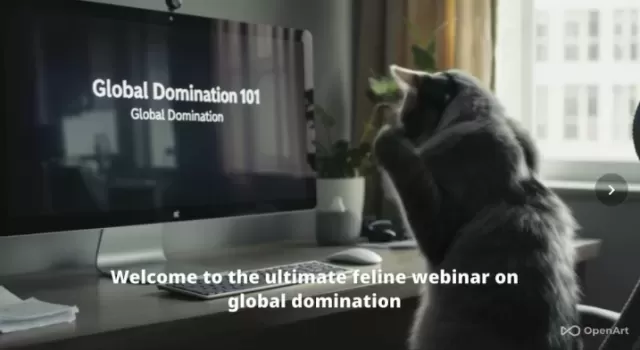
The internet is currently witnessing a surge in AI-generated content, particularly short-form videos characterized by surreal visuals and narratives, capturing the attention of younger audiences. Leading this trend is OpenArt, a startup established in 2022 by former Google engineers, boasting a user base of approximately 3 million monthly active users.
OpenArt recently unveiled a groundbreaking "one-click story" feature in open beta. This tool allows users to transform a single sentence, a script, or even a song into a complete one-minute video narrative. This capability extends across diverse applications, from crafting engaging TikTok content to producing informative explainer videos and compelling music videos for YouTube, with OpenArt even suggesting its potential use in advertising.
The "One-Click Story" feature offers three distinct templates: "Character Vlog," "Music Video," and "Explainer." When utilizing the "Character Vlog" option, users begin by uploading an image of their chosen character and providing a creative prompt. In the case of music videos, the software analyzes the song's lyrics to generate animations that visually reflect the song's themes, such as illustrating blooming flowers during lyrical references to gardens.
Users retain control over the creative process, with the ability to refine individual clips through the editor's storyboard mode by adjusting prompts. The platform consolidates over 50 AI models, granting users the flexibility to select their preferred tools, including DALLE-3, GPT, Imagen, Flux Kontext, and Stable Diffusion.
The primary objective of this new feature is to further simplify the process of becoming an AI creator, a field that remains exceptionally popular despite ongoing ethical discussions.
While these AI tools offer potential benefits, such as enabling the rapid creation of content featuring original characters and storylines, they also raise significant ethical considerations. These concerns include the potential for imitating the styles of established artists, questions surrounding intellectual property rights, and the risks associated with misuse and the creation of misinformation.
During initial testing, potential legal issues arose with the Character Vlog option due to the availability of characters resembling Pikachu, SpongeBob, and Super Mario. The unauthorized use of these characters could lead to intellectual property infringement. The legal landscape around AI-generated content is still developing as demonstrated by the lawsuit filed by Disney and Universal against Midjourney for alleged AI-generated image copyright violations.
Users need to be aware of potential consequences, including the removal of infringing videos from social media platforms and potential legal action from copyright holders.
According to Coco Mao, co-founder and CEO of OpenArt, the company is actively trying to avoid IP infringements. Mao stated that the models are designed to reject the use of protected IP characters, though sometimes such characters still appear in the generated content. OpenArt is willing to engage in discussions with major IP holders to explore potential licensing agreements.
OpenArt differentiates itself through its focus on character consistency within generated videos. Unlike video models that often produce disconnected clips requiring manual assembly, OpenArt aims to maintain consistency in both visuals and narrative.
According to Mao, the ability to maintain consistent character representation throughout a video is crucial for creating immersive experiences.
Looking forward, OpenArt plans to expand the capabilities of its one-click feature to enable videos featuring conversations between multiple characters. A mobile app is also in development.
OpenArt utilizes a credit-based subscription model, offering four plans. The basic plan costs $14 per month for 4,000 credits, which enables up to four One-Click stories, 40 videos, 4,000 images, and four characters. The advanced plan is priced at $30 per month for 12,000 credits and includes up to 12 One-Click stories. The Infinite plan costs $56 per month for 24,000 credits, and a team plan is available for $35 per member per month.
To date, OpenArt has secured $5 million in funding from Basis Set Ventures and DCM Ventures. The company reports positive cash flow and anticipates an annual revenue rate exceeding $20 million.